
If you are only going to do one round of serious lawn work all year in Princeton, do it in the fall. The lawns here are cool-season grasses — mostly tall fescue and perennial ryegrass — and they spend July and August simply trying to survive. September and October are when they actually grow. Core aeration and the right fall fertilizer in that window are the difference between a lawn that limps into next summer and one that comes back thick, green and able to take the heat.
Here is what each of those jobs actually does, what to put down on a Northeast lawn, what happens under the snow all winter, and what it costs you to skip.
1. Fall is when your lawn actually recovers
Cool-season grass does its best growing when air temperatures sit in the 60s and low 70s. By late summer a Princeton lawn has been through months of heat, drought stress, disease pressure and weed competition. Come September the air cools while the soil stays warm — the single best combination our climate offers for root growth and seed germination.
Spring work, by contrast, is mostly cosmetic. It pushes soft top growth right before the season that punishes the lawn hardest. Fall work goes into the parts of the plant you cannot see.
2. What core aeration actually does
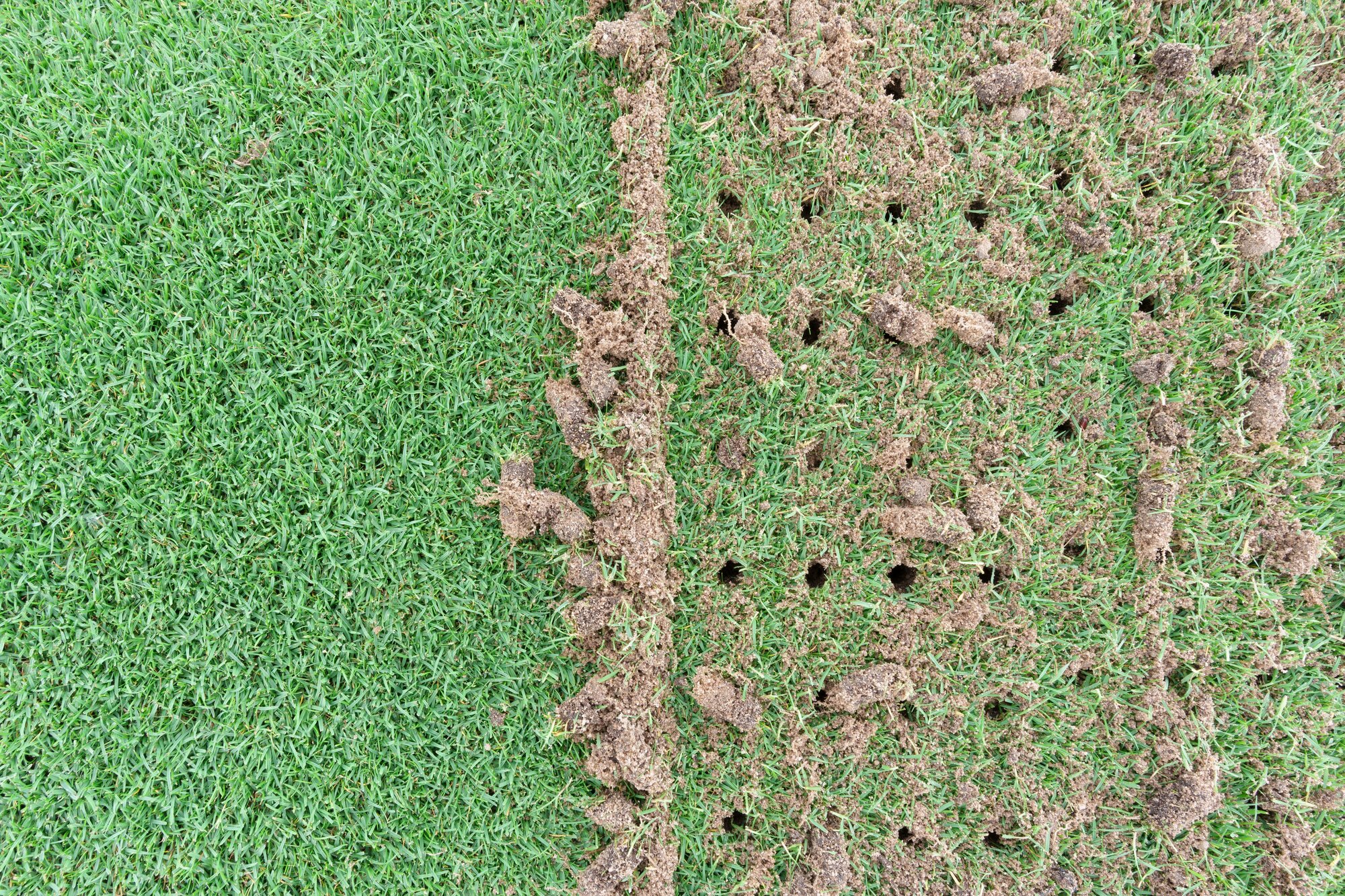
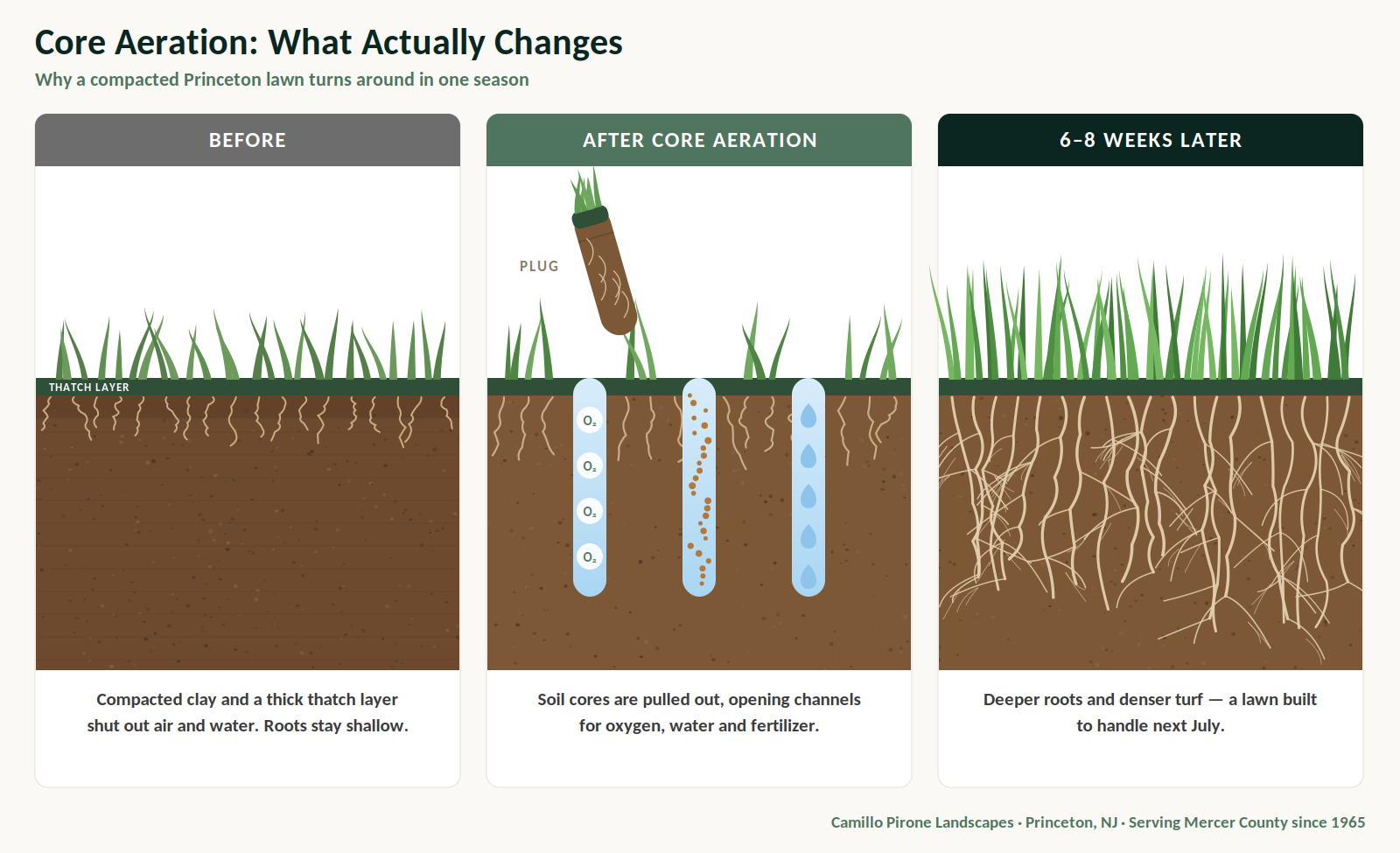
Core aeration pulls thousands of small soil plugs — roughly half an inch across and two to three inches deep — out of the lawn and drops them on the surface. That is the whole mechanism, and it matters that soil is removed rather than just pressed down. Spike aerators and rolling shoes push soil sideways and make compaction worse; a core aerator takes soil out and leaves an open channel behind.
Those channels change five things at once:
- They relieve compaction. Much of Mercer County sits on heavy clay, which packs tight under mowers, foot traffic, pets and play. Compacted clay physically stops roots from growing — they cannot push through it. Open channels give them somewhere to go.
- They restore air to the root zone. Roots respire. They need oxygen in the soil and they need carbon dioxide to escape. In compacted clay, the pore space that carries those gases is crushed closed, and roots suffocate slowly. This is the part most homeowners never hear about, and it is the reason the word is “aeration.”
- They let water in. On compacted ground, rain and irrigation run off toward the driveway and the street instead of soaking down. Aeration holes let water infiltrate to where the roots are.
- They break down thatch. The plugs carry soil microbes up onto the thatch layer, where they digest it. A thatch layer thicker than about half an inch sheds water and harbors disease and insects.
- They create seed-to-soil contact. Seed that lands in an aeration hole germinates. Seed broadcast onto hard, thatchy turf mostly does not.
There is a bonus effect: the tines prune some roots as they pass, and grass responds to root pruning by pushing out new lateral roots and shoots. The lawn thickens partly because it was disturbed.
Signs your lawn needs it: water pools or sheets off after normal rain; a screwdriver is hard to push into moist soil by hand; the turf feels spongy underfoot; thin patches under mature trees or along walkways; worn paths where people and pets cross; or it simply has not been aerated in several years. Most established lawns on Princeton-area clay benefit from annual core aeration.
3. The grasses we are actually feeding here
Fertilizer advice only makes sense once you know what is growing. In the Princeton region the overwhelming majority of home lawns are tall fescue, perennial ryegrass, or a blend of the two, often with some Kentucky bluegrass mixed in.
- Tall fescue is the workhorse of Northeast lawns. Deep-rooted, heat and drought tolerant, good in our clay, and reasonably shade tolerant. It is a bunch-type grass, meaning it does not spread to fill gaps — which is exactly why it needs overseeding to stay dense.
- Perennial ryegrass germinates fast, which makes it valuable in an overseeding mix, and it takes traffic well. It is less heat tolerant than fescue and less winter hardy, so it appreciates the potassium in a late-fall feeding.
- Kentucky bluegrass spreads by rhizomes and repairs itself, but it needs more water and more nitrogen than fescue and struggles in the shade common to older Princeton neighborhoods.
All three are cool-season grasses, which is why the fall calendar below works — and why the same schedule would be wrong in Georgia.
4. What fertilizer to use on a Northeast lawn
Every bag carries three numbers: nitrogen, phosphorus and potassium (N-P-K). Knowing what each one does makes the aisle much simpler.
- Nitrogen (N) drives color, density and recovery. It is the number that matters most in fall.
- Phosphorus (P) supports root and seedling development. On an established New Jersey lawn it is restricted by law — but it is permitted, and genuinely useful, when you are seeding.
- Potassium (K) is the quiet one. It improves cold hardiness, drought tolerance and disease resistance, which is why it belongs in the last application of the year.
For a tall fescue and ryegrass lawn in Princeton, that comes down to three products:
- A starter fertilizer, applied with aeration and overseeding. Something in the range of 12-12-12 or 18-24-12. The phosphorus is what new seedlings use to build roots, and New Jersey law allows it specifically when you are establishing or repairing turf.
- A slow-release, high-nitrogen fall fertilizer, early to mid fall. Look for a bag with a zero in the middle — analyses like 24-0-6 or 32-0-4 — and a high percentage of slow-release or controlled-release nitrogen on the label. New Jersey requires at least 20 percent slow-release; on clay soils that hold nutrients well, a higher slow-release percentage feeds more evenly and leaches less.
- A late-fall application with real potassium. Often sold as a “winterizer,” something like 20-0-8. By late October and early November soil is cooling, so a portion of readily available nitrogen is useful here — the grass takes it up and stores it rather than burning it on blade growth.
How much: Rutgers puts a cool-season lawn’s annual nitrogen need at roughly 1 to 3 lb per 1,000 square feet for a lower-input tall fescue lawn, and higher for irrigated bluegrass and ryegrass stands. New Jersey law caps you at 0.9 lb of nitrogen per 1,000 square feet per application and 3.2 lb per year, so the practical plan for most Princeton properties is two fall applications in the 0.7 to 0.9 lb range, with the bulk of the year’s nitrogen going down in fall rather than spring. Rutgers also notes that returning clippings instead of bagging them cuts a lawn’s nitrogen requirement by about half.
Organic options — composted manures, feather meal, biosolids-based products — work well on our clay because they feed soil biology along with the grass. They release slowly and need warm soil to break down, so they suit the September application better than the November one.
What to avoid: “weed and feed” combination products over newly seeded areas, since the herbicide will kill the seedlings you just paid for. And do not guess at nutrients. A soil test through Rutgers Cooperative Extension costs very little, and in this area it frequently comes back with a lime recommendation that matters more than the fertilizer itself.
5. The fall timing that matters in the Princeton area
Rutgers puts the ideal lawn renovation window for New Jersey at late August through late September. Seed planted then gets two cool growing seasons before it faces real summer stress, which is why fall seeding succeeds where spring seeding so often fails.
- Late August to late September: core aerate, overseed, and apply starter fertilizer
- Four to six weeks later, late October into November: the potassium-carrying late-fall application
- Through fall: keep mowing until growth stops, and keep leaves off the new seedlings
6. What New Jersey’s fertilizer law means for your lawn
New Jersey regulates lawn fertilizer more tightly than most states, and the rules shape the fall calendar:
- Blackout dates. Homeowners may not apply nitrogen or phosphorus fertilizer after November 15 and before March 1. Certified professional applicators have until December 1, with the same March 1 restart.
- Phosphorus is restricted on established lawns except when a soil test shows a deficiency or when you are establishing or repairing turf.
- At least 20 percent of the nitrogen must be slow-release.
- Rate limits: 0.9 lb of nitrogen per 1,000 square feet per application, 3.2 lb per 1,000 square feet per year.
- Buffers: 25 feet from water bodies, or 10 feet with a drop spreader, deflector or targeted spray. Never apply to frozen or saturated ground, or right before heavy rain.
The practical takeaway: fall applications have to be planned, not squeezed in at the last minute. Waiting until Thanksgiving is not an option.
7. Aerate and overseed in the same visit
The two jobs belong together. Aeration holes give seed the direct soil contact that determines whether it germinates at all, and the starter fertilizer goes down in the same pass. Overseeding every few years also keeps the stand genetically current — newer tall fescue varieties bring meaningfully better drought tolerance and disease resistance than a lawn seeded twenty years ago. For shady Princeton yards under mature canopy, choosing the right shade-tolerant blend matters as much as the aeration itself.
8. What happens over the winter — and why next spring looks different
This is the part that is easy to miss, because nothing visible happens for months.
Grass blades stop growing when air temperatures drop into the 40s, but roots keep working until soil temperatures fall to around 40 degrees — typically well into December here. Nitrogen taken up in late October and November is not spent on blade growth, because the plant is not making blades. It is converted into carbohydrates and amino acids and stored in the crowns and roots. Potassium applied at the same time thickens cell walls and improves the plant’s cold hardiness, which reduces winter injury and desiccation on exposed, windy sections of lawn.
Meanwhile the aeration holes keep working. Winter rain and snowmelt infiltrate through open channels instead of sheeting off frozen, compacted ground. And our freeze-thaw cycles do free labor: water in the opened soil expands as it freezes and fractures clay further, loosening structure in a way no machine can match.
Then March arrives, and the difference shows up:
- The lawn greens up earlier and more evenly, drawing on stored reserves instead of waiting for you to feed it.
- It comes out of winter denser, so crabgrass and broadleaf seed finds less bare soil to germinate in.
- It has a deeper root system heading into summer — which is the entire ballgame in a Princeton July, when the lawns that survive are the ones that can still reach moisture.
9. The three biggest benefits
- A thicker lawn that fights its own weeds. Dense turf is the most effective weed control there is. Every square inch of canopy is an inch where crabgrass seed does not get the light and bare soil it needs. This is how you spend less on herbicide, not more.
- Drought and heat tolerance next summer. Aeration plus fall feeding builds deep roots, and deep roots are what carry tall fescue through July and August without going dormant, browning out, or needing daily watering.
- Water goes into the lawn instead of off it. Better infiltration means less runoff and erosion, fewer soggy low spots, less fertilizer washing toward storm drains, and irrigation that actually reaches roots — so you water less and get more for it.
10. What happens if you skip it
Nothing dramatic happens in one year. The problem is that the effects compound:
- Compaction gets worse every season. Clay that is never opened keeps tightening, and the root zone gets shallower year after year.
- The lawn thins, and weeds fill the gap. Tall fescue is a bunch grass and does not spread to repair itself. Thin spots do not stay empty — crabgrass, nutsedge, clover and broadleaf weeds move in, and then you are paying for weed control instead of fertilizer.
- Thatch builds up. Without aeration, thatch accumulates, sheds water, and becomes a reservoir for fungal disease — brown patch is a regular problem on tall fescue in our humid summers — and a comfortable place for grubs and chinch bugs.
- Water runs off. You get dry, hard turf and simultaneously wet, mushy low spots, plus erosion at slopes and edges, plus wasted irrigation.
- Summer hits harder. A shallow-rooted lawn goes off-color, goes dormant early, and in a bad July can die out in patches rather than simply resting.
- Spring-only fertilizing makes it worse. Heavy spring nitrogen on a compacted, shallow-rooted lawn forces soft top growth, more mowing and more disease, without ever fixing the underlying soil problem.
The end of that road is a full renovation — killing off and re-establishing the lawn — which costs many times what annual aeration and two fall fertilizer applications would have.
11. After the work is done
- Leave the plugs. They break down within a couple of weeks and return soil and microbes to the surface.
- Water lightly and often until new seed germinates, then taper to deeper, less frequent watering.
- Keep mowing at about three inches until growth stops. Taller turf shades out weeds and protects the crown.
- Stay ahead of leaves. A wet leaf mat will smother young seedlings in days.
- Hold off on weed control over newly seeded areas until the new grass has been mowed a few times.
Ready to get your lawn ready for next year?
Camillo Pirone Landscapes has cared for lawns and landscapes across Princeton and Mercer County since 1965, and we handle core aeration, overseeding and fall fertilization as part of our full property maintenance and Princeton lawn and landscape maintenance programs. If you are planning bigger changes at the same time, our guide to planning a landscape design is a good next read.
Call (609) 921-0531 or request a free consultation, and we will walk your property and put together a fall plan that fits it.
